The 5-Minute Cyber Brief
Good morning. Start with the issue most likely to change what your team needs to pay attention to today, then move through the rest in under five minutes.
Lead Story
CISA: Windows Task Host flaw now exploited by ransomware gangs

CISA now flags Windows Task Host flaw CVE-2025-60710, patched in November 2025, as used in ransomware attacks. It lets a local attacker reach SYSTEM on Windows 11 and Server 2025.
Know what matters before your first meeting.
Weekday mornings. Five minutes. What changed in security, why it matters.
By subscribing you agree to our Privacy Policy.
Free. Weekday mornings. 5 minutes or less.
Why it matters: Since November 2021, 112 of 383 exploited Microsoft flaws in KEV have been tied to ransomware.
Recommended action: Find Windows 11 and Server 2025 systems still missing the November 2025 update.
Read more on CyberExperts: Read more on CyberExperts
Original source: BleepingComputer
Also Worth Your Attention
August 2026 Patch Tuesday: One Exploited Zero-Day and 62 Critical Vulnerabilities Among 415 CVEs
CrowdStrike notes that two of August’s publicly disclosed flaws are Windows privilege escalations, CVE-2026-62832 in User Profile Service and CVE-2026-62737 in the kernel, alongside CVE-2026-72971.
Why it matters: Publicly disclosed bugs attract exploit development quickly.
Recommended action: Pair the August updates with checks for local privilege escalation activity.
Read more on CyberExperts: Read more on CyberExperts
Clop created custom web shell for Windchill data theft attacks

ReliaQuest analyzed a custom Clop web shell for PTC Windchill and FlexPLM, used via CVE-2026-12569 and controlled through the X-windchill-req header to find and steal stored files.
Why it matters: PLM servers hold design data, a prime target for extortion.
Recommended action: Hunt for JSP files referencing X-windchill-req and rotate the Windchill LDAP manager password.
Read more on CyberExperts: Read more on CyberExperts
Attackers Exploit MLflow SSRF Flaw to Steal Cloud Credentials and Secrets

Attackers are exploiting an SSRF flaw in MLflow to reach cloud metadata services and steal credentials, while a separate FUXA issue is drawing malicious traffic against exposed systems.
Know what matters before your first meeting.
Weekday mornings. Five minutes. What changed in security, why it matters.
By subscribing you agree to our Privacy Policy.
Free. Weekday mornings. 5 minutes or less.
Why it matters: ML platforms are often run by data teams outside normal patch cycles.
Recommended action: Restrict MLflow exposure, block metadata access from ML hosts and update to the fixed release.
Read more on CyberExperts: Read more on CyberExperts
Hunting MacSync Stealer infrastructure through behavioral pivots
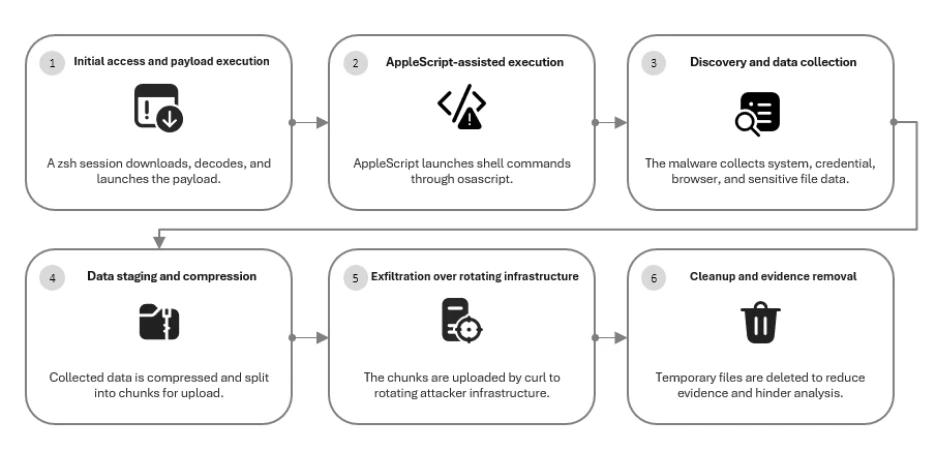
Microsoft found that MacSync Stealer keeps changing domains but reuses the same AppleScript-assisted collection and exfiltration pattern, which led to more than 30 related domains.
Why it matters: Behavior outlasts infrastructure, so domain blocklists alone will lag.
Recommended action: Hunt for AppleScript-driven collection and archive staging on managed Macs.
Read more on CyberExperts: Read more on CyberExperts
Go Deeper
Editorial Promise
CyberExperts should help you get the signal fast, understand what actually matters, and know where to go deeper before the day gets noisy.
Newer CyberExperts coverage on this topic
This article still works as background. If you want the current picture, start with the freshest related coverage below and today's brief.
Coder’s registry infrastructure compromised to push malicious modules
The Coder incident is a supply-chain lesson in miniature: once attackers can tamper with trusted module distribution, defenders are no longer verifying...
Attackers Turn Trusted Node.js Runtime Into Malware Delivery Tool in Targeted Attacks
The useful lesson in this campaign is not that Node.js is bad. It is that adversaries keep choosing legitimate runtimes defenders already...
HPE patches critical ArubaOS-CX remote code execution flaw
ArubaOS-CX deserves attention because switching software rarely gets treated with the same urgency as identity or edge security until exploitation arrives. A...
Monday’s brief: GlobalProtect logins without passwords, then SonicWall, AhsayCBS and NetScaler
The fastest way to catch up on what changed after this article was published.
Start your morning with the signal that matters.
Get the biggest cybersecurity developments, why they matter, and where to go deeper on CyberExperts.
By subscribing you agree to our Privacy Policy.
Free. Weekdays. Built for operators.