What Talos Observed
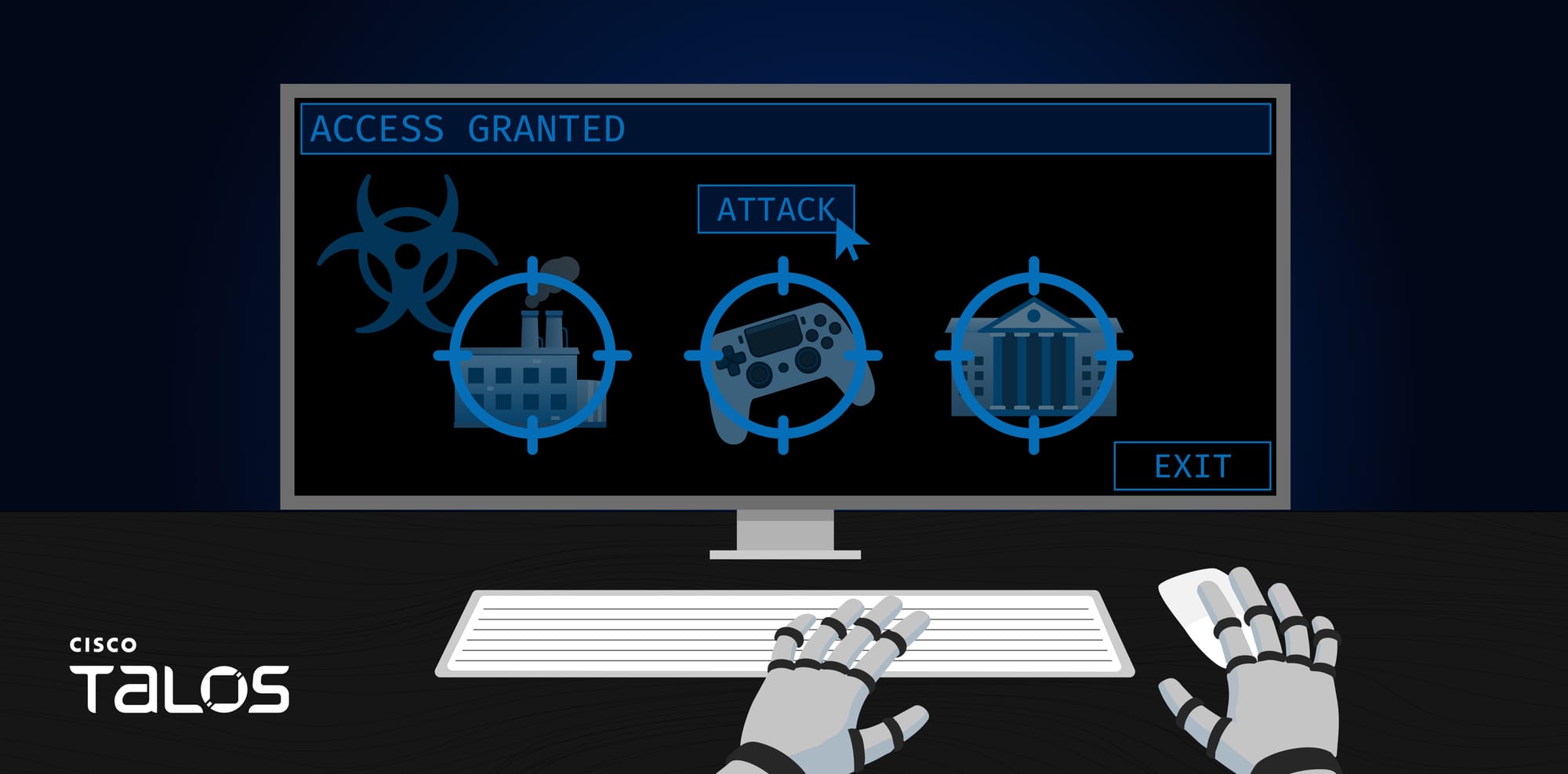
Cisco Talos says UAT-10147 is a Chinese-speaking intrusion operator targeting vulnerable Windows and Linux web servers globally, with victims spanning government, education, media, technology, and gaming.
The noteworthy part is not just initial access through public vulnerabilities. Talos says the actor integrated AI-driven tooling into exploitation, reconnaissance, payload generation, validation, and persistence workflows.
Why The AI Detail Actually Matters
Talos is careful to frame this as more than casual scripting help. The actor reportedly used AI-generated operational playbooks, exploit automation scripts, troubleshooting logic, and validation workflows, which points toward semi-autonomous offensive orchestration rather than one-off experimentation.
Know what matters before your first meeting.
Weekday mornings. Five minutes. What changed in security, why it matters.
By subscribing you agree to our Privacy Policy.
Free. Weekday mornings. 5 minutes or less.
That lowers the human effort needed to keep a campaign moving. If troubleshooting and iterative exploit refinement become easier to scale, defenders should expect more persistence from operators who would previously have stalled on complexity.
What Else The Campaign Shows
Talos says the actor used open-source offensive tooling including Metasploit, ysoserial, PentestGPT, DeepAudit, and multiple privilege-escalation exploits. The campaign also involved web shells and BadIIS malware as part of persistence and follow-on access.
Victim infrastructure reportedly mapped to a target list of roughly 170,000 URLs, with affected servers seen in countries including Brazil, Bolivia, China, Canada, and Vietnam. That scale reinforces the point that this is not a narrow hand-built intrusion.
What Teams Should Do Next
Use this story to sharpen assumptions about post-compromise speed.
Know what matters before your first meeting.
Weekday mornings. Five minutes. What changed in security, why it matters.
By subscribing you agree to our Privacy Policy.
Free. Weekday mornings. 5 minutes or less.
- Review whether exposed web servers are patched and whether web-shell detection is strong enough to catch follow-on persistence quickly.
- Hunt for BadIIS-style behavior, suspicious download-server communication, and unusual post-compromise automation on Windows and Linux web infrastructure.
- Assume exploit troubleshooting and payload refinement may now happen faster than older response models expect.
- Make sure detections cover the open-source offensive frameworks named by Talos rather than only bespoke malware families.
- Use this research to pressure-test whether your team still assumes advanced post-compromise activity requires more manual attacker effort than it now does.
Source Context
CyberExperts used Cisco Talos as the primary source for this article and preserved the parts that matter most to defenders: UAT-10147's victim sectors, the AI-assisted tradecraft, the open-source frameworks in use, the BadIIS and web-shell persistence angle, and the global scale of the target set.
Related In The Daily Brief
See this item in The 5-Minute Cyber Brief
Newer CyberExperts coverage on this topic
This article still works as background. If you want the current picture, start with the freshest related coverage below and today's brief.
Coder’s registry infrastructure compromised to push malicious modules
The Coder incident is a supply-chain lesson in miniature: once attackers can tamper with trusted module distribution, defenders are no longer verifying...
Attackers Turn Trusted Node.js Runtime Into Malware Delivery Tool in Targeted Attacks
The useful lesson in this campaign is not that Node.js is bad. It is that adversaries keep choosing legitimate runtimes defenders already...
HPE patches critical ArubaOS-CX remote code execution flaw
ArubaOS-CX deserves attention because switching software rarely gets treated with the same urgency as identity or edge security until exploitation arrives. A...
Monday’s brief: GlobalProtect logins without passwords, then SonicWall, AhsayCBS and NetScaler
The fastest way to catch up on what changed after this article was published.
Start your morning with the signal that matters.
Get the biggest cybersecurity developments, why they matter, and where to go deeper on CyberExperts.
By subscribing you agree to our Privacy Policy.
Free. Weekdays. Built for operators.