Updated for 2026: I originally wrote this after I passed CISSP the hard way — audio, video, and relentless practice questions, not a boot camp and not a stack of thick books. The core of that story still holds. What has changed is the exam delivery (CAT worldwide), the fee, and the official outline. Below I keep my first-person path, then spell out what is still true versus what you should plan around in 2026.
I passed the CISSP without reading any books. I did it with audiobooks, video training, and months of practice questions. That approach still beats a expensive boot camp for many people like me — especially if reading long chapters is not how you actually learn.
What still holds in 2026
A few things have not gotten softer since I sat the exam:
Know what matters before your first meeting.
Get the weekday cyber brief for hiring signals, skills shifts, and major cyber developments shaping the market now.
By subscribing you agree to our Privacy Policy.
Free. Weekday mornings. 5 minutes or less.
- Pearson VUE security is intense. The CISSP is delivered at ISC2-authorized Pearson VUE PPC and PVTC Select centers. IDs get checked and double-checked. Biometrics. Cameras. A live proctor. Nobody is whispering you the answer key.
- Nobody can tell you the questions. Not a boot camp. Not a “dump” site. Not a friend who sat last week. The item bank is huge, and the only honest path is knowing the eight domains well enough to reason under pressure.
- Eight domains still define the credential. The weights shifted slightly with the April 2024 outline refresh (still the outline used into 2026), but the shape of the exam is the same: broad, management-leaning cybersecurity judgment across the CISSP domains.
- Practice beats boot camp for many of us. Week-long cram classes still sell the fantasy of inside information. What actually moved my score was becoming an expert at analyzing multiple-choice (and now advanced) items — eliminating bad answers even when the scenario was unfamiliar.
What’s new for the 2026 exam
When I took CISSP, the experience felt like a long, linear grind. Today the exam uses Computerized Adaptive Testing (CAT) worldwide. Plan for the current ISC2 facts (verify on ISC2’s CISSP exam outline page before you schedule):
- Length: up to 3 hours
- Items: 100–150 (multiple choice and advanced item types)
- Passing score: 700 out of 1000
- Languages: Chinese, English, German, Japanese, Spanish
- Testing centers: ISC2 Authorized PPC and PVTC Select Pearson VUE centers
- Exam fee: U.S. $749 in the Americas and other standard USD regions (pricing and taxes vary by location; EMEA/UK list local currency). Pearson reschedule is typically U.S. $50; cancel U.S. $100 (deadlines apply).
- After you certify: ISC2 members pay a single annual maintenance fee of about U.S. $135/year (covers multiple ISC2 certs you hold) — budget it, don’t obsess over it while you study.
Current outline (as of 2026): the last major domain refresh took effect April 15, 2024, and that outline is still what candidates should study to. Domain weights:
- Security and Risk Management — 16%
- Asset Security — 10%
- Security Architecture and Engineering — 13%
- Communication and Network Security — 13%
- Identity and Access Management (IAM) — 13%
- Security Assessment and Testing — 12%
- Security Operations — 13%
- Software Development Security — 10%
Experience: you generally need five years of cumulative full-time paid work experience in two or more of the eight domains. A four-year degree or an approved credential can waive one year. If you pass the exam without the experience, you can become an Associate of ISC2 and earn the years afterward.
AI and ML, briefly: ISC2 does not treat artificial intelligence as a ninth domain. In the current framing, AI/ML security themes — governance, data and model integrity, defensive tooling, and secure development implications — are woven across the existing domains. You do not need a separate “AI cert” to sit CISSP, but you should expect modern risk language, not a 2018-only vocabulary.
Reading is not my best learning style
In a world of podcasts and video, fewer people honestly learn best by reading and writing alone. For me, that is certainly the case.
I love learning through audiobooks and video training. I used those methods exclusively to pass difficult IT certification exams, including CISSP. Thick guides never stuck — I could finish a chapter and realize I barely remembered it. Re-reading the same pages for hours was not a strategy I could sustain.
No expensive boot camp needed
I am not a fan of CISSP boot camps. Too many week-long programs sell the idea that if you cough up thousands of dollars, you will get inside information on what will appear on the exam. That is not how this works.
Boot camps can help some people structure study time. They cannot hand you the questions. If someone implies otherwise, walk away.
Nobody can tell you what questions you will encounter. No one.
I have never seen security this high on a certification test. The CISSP is available at specific Pearson VUE locations with strict controls. Your IDs are checked and double-checked. You will do biometric scans. You will be on camera the entire time, and a live person will watch you as well.
Given that security and the size of the item pool, there is no honest shortcut through “brain dumps.” The only way to conquer CISSP is to know the eight domains deeply enough to think like a security professional — and to practice how the exam asks questions.
But there is a trick
Because CISSP covers such a vast array of topics, it is nearly impossible to know every answer cold. When I took the exam, I was confident on roughly 75% of the items. Seventy-five percent will not get you a passing score. (If you have already sat the exam and missed, here is why people fail the CISSP and how to pass on the retake.)
The trick is to become an expert test taker — specifically, an expert at dissecting multiple-choice (and, today, advanced) items. There is an easy way to master that, but it takes a lot of time: practice, review why answers are right or wrong, and repeat until elimination and judgment feel automatic.
Three months, no books — my original path
That is a tall claim, but I know it worked for me. I started studying in January and passed on March 20. I did not have the patience for the giant official guides. Audio and video plus practice questions did.
What I used then (historical — do not treat 2018 materials as your primary 2026 source):
- Week 1: An overview audiobook mapped to the 2018 CISSP Body of Knowledge — useful then as a flyover, outdated now as a primary text. Today, start from the current ISC2 CISSP Exam Outline PDF instead.
- Week 2: Free CISSP videos on Cybrary. Good as a starting point if the course still maps to the current outline — verify currency before you lean on it alone.
- Week 3: An audiobook of thousands of sample questions. That is when I realized I was not ready.
- Week 4: Cybrary again — painful, but the material finally connected to how questions were asked.
- Weeks 5–10: Practice exams on cccure, recommended by three people I trusted at church and work. I hammered every question, reviewed every explanation, and honestly expected to see the same items on exam day.
I was dead wrong — and that was the real lesson
The live exam did not recycle my practice bank. A handful of items felt similar; none were the same. Most were entirely different.
But those weeks of practice taught me the skill that actually passed me: how to analyze a question. Even on topics where my knowledge was thin, I could discard one or two distractors immediately, then choose among the rest with calculated judgment. Practice did not teach me to memorize dumps. It taught me how the exam thinks.
That insight still matters on CAT. Adaptive delivery does not reward memorizing a fixed set of items. It rewards domain fluency and calm elimination under time pressure.
A 2026 study plan (audio / video / practice, ~3 months)
Here is how I would parallel my original path today — same learning style, current resources:
- Start (weeks 1–2): Download the official ISC2 CISSP Exam Outline (current as of 2026; last major refresh April 2024). Pair it with one current overview audio or video course that explicitly maps to that outline — not a 2018 audiobook. Free video platforms (including Cybrary, if the CISSP track is current) can still be a low-cost start; confirm the syllabus against the outline before you binge.
- Mid (weeks 3–6): Move into a high-quality practice bank aligned to the current outline. Strong options candidates commonly use include ISC2 Official Practice Tests / Official Study Guide practice, Boson, Destination Certification, and other well-reviewed adaptive banks. I used cccure successfully in my era; for 2026, verify any bank’s reputation and outline alignment rather than assuming one site is still “the” answer. Do not expect identical items on exam day.
- Late (weeks 7–12): Timed sets. Review every miss. Weight your weak domains by exam weight — start with Security and Risk Management (16%), then hammer Architecture, Network, IAM, and Operations (13% each). Keep drilling until you can eliminate answers on unfamiliar scenarios without panic.
- Throughout: Commute audio and phone video still work if that is how you learn. Just make sure the content is mapped to the current outline, not nostalgia.
Keep the insight that passed me: practice teaches how to eliminate answers even when items are unfamiliar. That is the point — not collecting a secret question list.
I passed the CISSP exam on my birthday
The test was expensive, and I was not sure I was ready. Honestly, I worried more about wasting the exam fee than about anything else. Back then it was about $700; today you should budget U.S. $749 in standard USD regions (plus any local tax) — still a lot of money to throw away.
I scheduled for March 20 — my birthday. Passing CISSP would be my present to myself.
After the audiobooks, the videos until my brain hurt, and weeks of practice questions, I walked into the high security of the test center. Hour after hour of unexpected questions.
I walked out and found that I passed.
If reading is not your style either, you can still get there — with current materials, honest practice, and respect for how hard Pearson VUE and ISC2 lock this exam down.
Where to go next
Planning your next certification? See the full certification roadmap for the order to take them by career goal. After CISSP, CISM is the natural next step if you are moving into security management, and CCSP fits cloud-heavy roles (an active CISSP satisfies CCSP’s experience requirement). If you would rather stay hands-on, CompTIA SecurityX is the technical alternative; I compared the two in my CASP vs CISSP write-up.
For the broader certification landscape in 2026, start with our guide to the best cybersecurity certifications in 2026. Browse more career paths in Cyber Security Careers, and keep a pulse on threats and news with the CyberExperts Daily Brief.
Newer CyberExperts coverage on this topic
This article still works as background. If you want the current picture, start with the freshest related coverage below and today's brief.
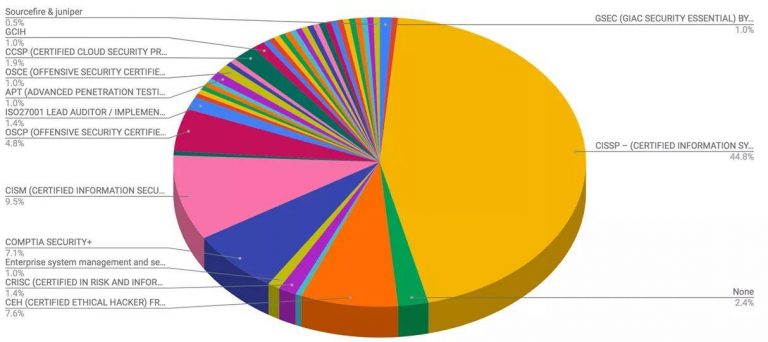
What is the best IT certification to have?
A picture is worth a thousand words. There are a ton of IT certifications but the monster of all certifications is the...
CASP (Now SecurityX) vs. CISSP – My Experience
Editor's note (September 2026): CompTIA renamed CASP+ to CompTIA SecurityX when it launched the CAS-005 exam on December 17, 2024, and the...
The Top 20 Cities for CISSPs
We analyzed the job postings, crunched the data, and determined the actual value of the CISSP certification to list the top 20...
Tuesday’s brief: GitLab’s critical fix, then Patch Tuesday, hijacked fridge controllers and Server 2012’s last update
The fastest way to catch up on what changed after this article was published.
Start your morning with the signal that matters.
Get the biggest cybersecurity developments, why they matter, and where to go deeper on CyberExperts.
By subscribing you agree to our Privacy Policy.
Free. Weekdays. Built for operators.