The 5-Minute Cyber Brief
Good morning. Start with the issue most likely to change what your team needs to pay attention to today, then move through the rest in under five minutes.
Lead Story
Metabase SQLi zero-day exploited in customer data-theft attacks
Metabase says attackers used an unauthenticated SQL injection flaw in versions 1.58 and later to compromise Metabase Cloud, and self-hosted instances are affected too. Framework and Tally disclosed data-theft impact.
Know what matters before your first meeting.
Weekday mornings. Five minutes. What changed in security, why it matters.
By subscribing you agree to our Privacy Policy.
Free. Weekday mornings. 5 minutes or less.
Why it matters: Admin access to Metabase exposes stored credentials for every connected database.
Recommended action: Apply Metabase’s patched release, then rotate the database credentials stored in the instance.
Read more on CyberExperts: Read more on CyberExperts
Original source: BleepingComputer
Also Worth Your Attention
Progress Kemp LoadMaster Flaw Hits CISA KEV After 792 Reported Exploit Attempts

CISA added Progress Kemp LoadMaster command-injection flaw CVE-2026-8037 to KEV on August 7. KEVIntel had logged 792 exploit attempts over 41 days from 65 IPs in 18 countries.
Why it matters: Load balancers sit in front of key applications, so an unauthenticated foothold there is valuable.
Recommended action: Find every LoadMaster appliance, confirm the fixed version and restrict management access.
Read more on CyberExperts: Read more on CyberExperts
Hackers breach TrueConf to trojanize client installers with backdoors

Kaspersky says the Head Mare group exploited unpatched TrueConf video-conferencing servers and replaced client installers with versions carrying the PhantomCore backdoor. The attackers reached servers on TCP port 4307 without authentication.
Why it matters: Users of other organizations’ compromised TrueConf servers can receive the trojanized client too.
Recommended action: Patch TrueConf servers, close port 4307 to the internet and verify client installers.
Read more on CyberExperts: Read more on CyberExperts
128 Seconds to disruption: Microsoft Defender stops ransomware at QNET
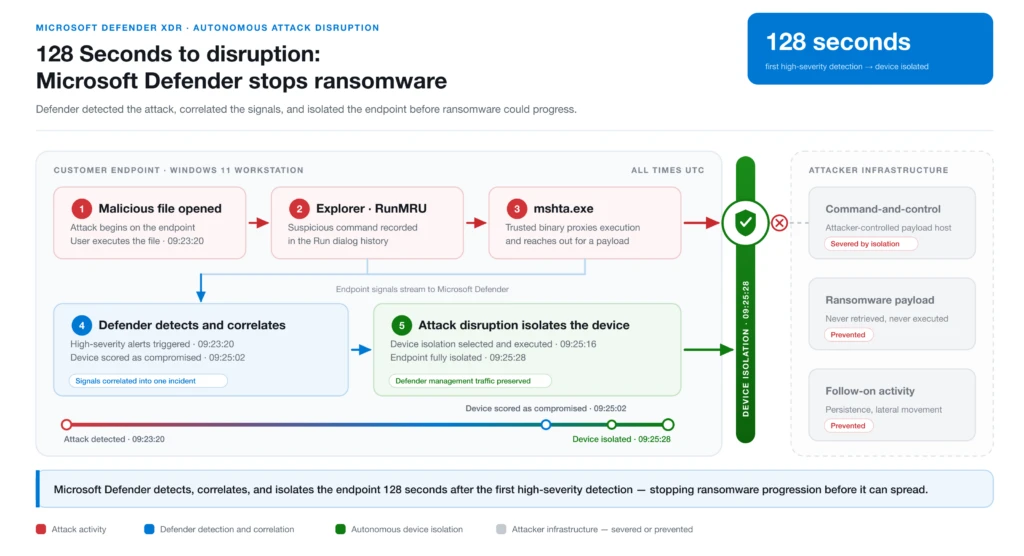
Microsoft’s QNET case shows Defender isolating an endpoint in 128 seconds. The new automatic isolation works on onboarded Defender for Endpoint workstations and is time-limited.
Know what matters before your first meeting.
Weekday mornings. Five minutes. What changed in security, why it matters.
By subscribing you agree to our Privacy Policy.
Free. Weekday mornings. 5 minutes or less.
Why it matters: The time from first alert to containment often decides whether one machine becomes an outage.
Recommended action: Measure your own detection-to-containment time for a workstation and compare.
Read more on CyberExperts: Read more on CyberExperts
“Keep going, bro. You’ve got this!” A data-driven look at how adversaries are weaponizing AI
Talos analyzed prompt logs from attacker machines running Claude Code, Codex, Cursor and Gemini. Simple claims of ownership or bug-bounty framing got past guardrails, and an actor’s skill decided how much damage the AI help did.
Why it matters: Weak actors become more productive and strong actors faster.
Recommended action: Treat AI prompt logs found during incident response as evidence of intent and targets.
Read more on CyberExperts: Read more on CyberExperts
Go Deeper
Editorial Promise
CyberExperts should help you get the signal fast, understand what actually matters, and know where to go deeper before the day gets noisy.
Newer CyberExperts coverage on this topic
This article still works as background. If you want the current picture, start with the freshest related coverage below and today's brief.
Coder’s registry infrastructure compromised to push malicious modules
The Coder incident is a supply-chain lesson in miniature: once attackers can tamper with trusted module distribution, defenders are no longer verifying...
Attackers Turn Trusted Node.js Runtime Into Malware Delivery Tool in Targeted Attacks
The useful lesson in this campaign is not that Node.js is bad. It is that adversaries keep choosing legitimate runtimes defenders already...
HPE patches critical ArubaOS-CX remote code execution flaw
ArubaOS-CX deserves attention because switching software rarely gets treated with the same urgency as identity or edge security until exploitation arrives. A...
Monday’s brief: GlobalProtect logins without passwords, then SonicWall, AhsayCBS and NetScaler
The fastest way to catch up on what changed after this article was published.
Start your morning with the signal that matters.
Get the biggest cybersecurity developments, why they matter, and where to go deeper on CyberExperts.
By subscribing you agree to our Privacy Policy.
Free. Weekdays. Built for operators.