
Tuesday, April 14, 2026
Home Blog Page 301
AI cybersecurity guidance for small businesses

Know where your business is exposed, what matters most, and what to fix first.

CyberExperts gives small businesses AI-generated cyber checkups, practical recommendations, and recurring cyber hygiene monitoring — without enterprise consulting complexity.

AI Cyber CheckupIdentify likely weak points and get a prioritized action plan.
Recurring MonitoringStay current with updated cyber hygiene guidance over time.
Built for SMBsPractical recommendations for real-world small business setups.

Most small businesses know cybersecurity matters. Very few know what to fix first.

CyberExperts turns cybersecurity confusion into a practical action plan. Instead of vague fear, generic checklists, or expensive consulting, you get AI-generated guidance focused on likely risks, weak spots, and the most important next steps.

How it works

1. Tell us about your businessShare your team size, tools, email setup, device practices, and current security habits.
2. CyberExperts analyzes your setupOur AI reviews likely weak points, common risks, and practical cyber hygiene gaps.
3. Get a prioritized action planReceive clear next steps in plain English — focused on what matters most.
4. Stay current with ongoing monitoringAdd recurring cyber hygiene monitoring if you want updated guidance over time.

Start with a checkup. Continue with monitoring.

AI Small Business Cyber Checkup

A one-time AI-generated assessment that identifies likely weaknesses, highlights the biggest issues, and gives you a practical action plan.

  • Likely weak points and avoidable risks
  • Top-priority recommendations
  • Plain-English next steps

AI Cyber Hygiene Monitor

A recurring cyber hygiene subscription that updates your recommendations, flags likely weak spots, and helps you stay current over time.

  • Recurring reassessment
  • Updated recommendations
  • Refreshed priorities over time

What CyberExperts does — and does not do

Done by AICyberExperts is built as an AI-delivered cybersecurity guidance product.
For small businessesDesigned for operators who want practical guidance without enterprise complexity.
Not a magic guaranteeIt helps identify likely risks and prioritize what to fix first.
Recurring option availableContinue with ongoing Cyber Hygiene Monitor updates over time.

See your biggest cybersecurity gaps in plain English.

Start with an AI Cyber Checkup and get a practical view of what to fix first.

Cybersecurity Alliances – A Complete Guide

In the English Poet Jon Donne’s (1624) words, “No man is an island, entire of itself.” This statement is true for nations, corporations, and individuals. In an article about “The Importance of Alliances for U.S. Security” published on Heritage.org, Martin Murphy states that “states of roughly equivalent weights may feel emboldened to pursue riskier foreign policies because their allies are obligated to come to their rescue.” An alliance can be a formal, written treaty or an informal, unwritten agreement based on anything that ranges between tacit understandings and verbal assurances.

The primary goal of any alliance is to advance the members’ collective interests through combining and leveraging their capabilities, such as financial, skill, and military resources. This purpose is based on the fact that no single state or business can provide all capabilities and proficiency needed to accomplish a sophisticated task.

The Age of Cybersecurity Alliances is Nigh

One of the best strategies companies have come up with to curb cyberattacks is to form cybersecurity alliances. Companies come together with a common interest in sharing technical data and intelligence on the ever-evolving cyber threats. Such alliances feature strong public and private partnerships that promote the creation and implementation of measures to empower individuals and organizations to secure their systems and sensitive information online while encouraging a cybersecurity culture.

Why are Companies Warming Up to Cybersecurity Alliances?

In most cases, governments focus on securing companies and citizens in the physical world. However, in the digital space, they are investing in building their offensive capabilities at the expense of keeping companies and individuals safe from cyber threats. This observation can be attributed to the governments’ view that cyberthreats are not impacting a nation’s safety hugely. Unfortunately, the emerging trends in cyberspace (Internet coverage, cloud computing, IoT, cyber-physical systems) and increasing sophistication of cyberattacks make cybersecurity an essential aspect of human safety.

Key players in the digital world realm, such as Samsung, HP, and Siemens, have channeled their efforts to develop cyber threat defense. This is in response to the low involvement of federal protection agencies in cybersecurity. Alliances such as the Global Cyber Alliance (GCA) were formed to bring together vendors and end-users to create an open platform to exchange insights, information, analytics, and event solutions.

When a breach occurs, there tends to be a breakdown of trust between policymakers and customers. Cybersecurity alliances bridge the trust gap. Companies’ tight-knit and compact groups uphold values such as accountability and trust to promote peace among the members. Alliances enable companies to work in harmony towards a common goal of securing a future for digital networking. When these companies work hand in hand, not only are they able to curb threats, but they also stay updated on upcoming or future threats through a pooling of information. Alliances offer an administrative and operational framework that is reliable, flexible, and reflective of cybersecurity market needs.

Types of Cybersecurity Alliances

There are two major types of partnerships in terms of the purpose they serve. Different companies come together and form pacts for various reasons. The aim to which an alliance is created may vary following its members. The two types of partnerships are normative alliances and operational alliances.

1.     Normative Alliances

These alliances provide support to companies vulnerable to cyber threats. One of the critical purposes of normative alliances is to seek government support on cybersecurity matters. This involves vouching for a limit on the use of private networks by a state on its citizens. Due to the low government concerns on cybersecurity issues, normative alliances allow companies to draw their line of defense against the threats facing them. Peace and order must prevail among the members for them to work together effectively. Trust is a significant prerequisite ingredient of peace. Normative alliances such as the Charter of trust uphold trust as a key value within the coalition.

Normative alliances are aimed at renegotiating the social contract between state governments and their citizens. Through the sharing of varying tactics of combating cyberthreats, normative alliances change how companies approach these vulnerabilities. Pioneered by Microsoft and other major companies, the cybersecurity accord aims to promote “a safer online world by fostering collaboration among global technology companies committed to protecting their customers and users and helping them defend against malicious threats.” The open letter to the G7 government to prioritize cybersecurity is a step by normative alliances to push the state to apply more concern on digital issues.

2.     Operational Alliances

These are based on smaller groups of companies keen on sharing technical data and intelligence on cybersecurity. These member companies share their experience and tactics on cyberattacks and threats. One of the primary reasons companies form operational alliances such as the Cyberthreat alliance and Trusted Computing group is keeping their IT or CISCO departments apprised of current attacks or threats. The program launched by the national cybersecurity alliance to educate SMEs on better protection strategies against cyber threats is an excellent example of the roles that operational partnerships play.

Popular Cybersecurity Alliances

Many leading IT companies like Airbus, Samsung, and Google (to mention a few) have come together to tackle cyber threats collectively. Major key alliances in the tech realm are;

1.     Cyberthreat Alliance

Also known as CTA. It has been in existence since 2014 after an informal pact agreement between Fortinet, Palo Alto Networks, Symantec, and McAfee. It is mainly a sharing platform for member companies. The alliance boasts of adhering to five principles that govern its mannerisms. The laws are context rules, time is of the essence, radical transparency, for the greater good, and you must give to receive. The alliance is based on the value of trust, efficiency, and unity.

In CTA, the efficient and timely sharing of information is one of the constituents of its success over the years. In case of a new kind of malicious cyber threat, the information is shared promptly across the members to ensure they are aware and protected. It also gives a good chance for creating solutions to cyberthreats through the sharing of ideas or strategies. The alliance requires all members to share a minimal amount of intelligence to avoid the free-rider problem. This ensures all members are active and involved in the process. All members are treated with equity regardless of their position in the market. CTA focuses on defending the digital ecosystem.

2.     Trusted Computing Group

First established in 1999 under the name Trusted computing performance alliance. The group was founded by MicrosoftHewlett-PackardIntelIBM, and AMD. The alliance was announced in 2003 under its current title to succeed the prior alliance. Other companies have then joined. TCG ensures secure computing through the protection of user data across devices and storage. The group currently operates with a minimum of 100 members from all over the world. A trusted computing group offers a wide range of data security solutions to its members. Some of these services include; data storage device encryption alerts on malware and encryption of data transmittance. The alliance strongly emphasizes trust among its members.

3.     Global Cyber Alliance (GCA)

The GCA is a robust international alliance formed by Sony, Adobe, Attivo Networks, Symantec, Juniper Networks, MasterCard CyberSecOn, Microsoft, Telos, Bloomberg, and Verizon. The group was formed mainly as a cross-sector effort to eradicate cyber risk and improve our connected world. The group’s mission is achieved through a qualitative assessment of the impact the alliance has on cyberspace. GCA focuses on uniting the global community across all geographical locations and sectors. The members enjoy freely available cybersecurity solutions provided by the alliance. Since its formation in 2015, GCA has seen an increase of members from the pioneering three organizations. Now there are over one hundred members.

4.     The National Cyber Security Alliances (NCSA)

The alliance is a unique partnership between the federal government, educational organizations, trade associations, and leading private sector companies to provide a secure internet experience. In 2002, the group envisioned providing a safer digital experience as a recipe for; free flow of content, reliable and widely available connectivity, trustworthy commerce, and the creation of multiple communication platforms. NCSA is Governed by a very devoted and involved cadre of volunteer leaders from CISCO, Microsoft, RSA Security Inc, America online, and BellSouth Inc. Small businesses, institutions, and home users are the primary target audience of the alliance. Through the unique private-public partnership, the coalition focuses on promoting computer safety and ethical behavior online.

5.     International Cyber Security Protection Alliance (ICSPA)

ICSPA is a not-for-profit organization that supports law enforcement units globally in their efforts against cybercrime. The alliance was formed to offer funding, expertise, and support to assist law enforcement agencies in handling malicious cyber activities, both in local and international markets. ICSPA membership includes national and multi-national corporations recognizing the importance of providing resources and other assistance to law enforcement departments in their fight against cybercrime.

Governments and institutions that understand the need to support other countries in the fight against cybercriminals support ICSPA. The alliance, in turn, channels the resources to beneficiaries to increase their knowledge, capabilities, skills, capacity, and expertise needed to reduce the impact of cyberthreat on businesses, customers, and citizens around the world.

6.     International Alliance under NATO’s Cybersecurity Policy

Cybersecurity is an important topic of NATO’s summit agendas since the 2002 Prague summit, where Allied leaders acknowledged the need to defend against cyber threats. NATO’s purpose as a cyberspace alliance states, “We must be able to operate as effectively in cyberspace as we do in the air or land, and at sea to strengthen and support the Alliance’s overall deterrence and defense posture.”

In 2014, NATO released the first cyber defense policy for adoption and had continually upheld it with cyberspace’s recognition as a domain for military operations among the 28 member states. NATO’s purpose statement reveals that military activities can only be achieved through military means and cyber defense efforts. Over the years, the Alliance and its allies have placed technical and operational strides to mitigate cyber threats.

7.     Other Cybersecurity Alliances

Other vendors in cyberspace partner with one another to enhance their protection against broader threat vectors and increase their capabilities in curbing cyber incidents at different phases. In this case, one party can be assigned prevention and detection while the other mitigates and recovers.

The Success of Cybersecurity Alliances

Digital technology’s success depends on broader connectivity. Therefore, when companies come together, they create a pooling of ideas and information on the current cyber threats. The companies are, consequently, left in a better position to evade or combat the ever-evolving cyber-attacks. So far, these alliances have proved to be beneficial. The president of France recently launched the  “Paris Call for Trust and Security in Cyberspace,”  This was one of the greatest mileages covered in terms of governments being pushed to invest in cyberspace security. This was a symbolic pledge by the state to improve international standards and cybersecurity practices. Sixty-three countries also joined the revolutionary move along with many other companies, civil and international society organizations.

Some factors, however, have been seen to derail the attainment of the full potential of cybersecurity alliances. Unhealthy competition among businesses and companies is a significant flaw in searching for reliable solutions to cyber threats. Some of the cyberattacks are orchestrated by competing companies to stall their competitors. This can also be a derailing factor if such a company is a member of an alliance, with access to the group’s information. As with any other venture, malpractices are numerous in the digital networking world. As companies come together to combat cyberspace risk, other companies fund the cyberattacks for their gain.

Governments have greatly influenced the slow pace of alliance success. Isolation retards the effort to address cybersecurity issues collectively. Digital separation is one of the worst forms of jeopardy to the cooperative efforts of cybersecurity alliances. State-funded hackers hide behind national firewalls to attack other governments and companies with malicious intent.  This indicates the negative contribution of federal policies to the war against cybercrimes.

Do Companies with IT Security Departments Need to Join a Cybersecurity Alliance?

With the increase in cyber threat vulnerability, most IT companies have internal cybersecurity departments. These departments are solely meant to mitigate any possible cyber attacks that may be attempted on their company. These departments are single units with limited capabilities as compared to a comprehensive source of an alliance. Most of these companies are victims of the same cyber threats. It is, therefore, apparent that any of these cybersecurity departments would immensely benefit from a more significant source of solutions and information in regards to the cyberthreat. These departments’ work is to identify risk points and apply the best solutions and practices. Joining an alliance would help a company learn of possible risk points and have various solutions to choose from.

Cybersecurity alliances not only offer solutions to their members but also promote digital peace. Alliances seek assistance from the government, especially for companies under attack. Although they seem stable, these groups always ask for help from other agencies. While doing this, they ensure a calm digital ecosystem by upholding accountability and trust as core values. While every company does not need to join the alliances, it is still essential for most web-based companies to work collectively. If one company falls prey to a cyber-attack, the others will help find possible solutions to the attack. The alliances are based on symbiotic relationships where all parties are gaining. Apart from the victim companies, the other member companies would also benefit from gaining insight into combating a cyber threat in the event of an attack.

Joining an alliance would significantly improve the capabilities of the cybersecurity departments in companies. They would be more equipped with a broader scope of possible risk points and possible solutions for the risks. Hackers have well-established and organized communities where they cooperate to infiltrate other digital systems. Therefore, it makes perfect sense to combat these cyber threats in a collective organized manner. The scope of these cyber-attacks is everchanging.

Benefits of the Alliances to Organizational Cybersecurity

Cybersecurity has remained to be a key challenge for most organizations. Emerging IoT, 5G networks, and sophisticated cyber-physical systems have caused cybersecurity to be extremely complicated. If a data breach occurs, as was the case with Equifax, British Airways, and Facebook, trust existing between businesses and key policymakers might be affected. Hence, enterprises bridge this trust gap through cyber alliances, and more importantly, achieve better cyber defenses. As previously mentioned, normative and operational are the main types of cyber alliances. They both purpose to ensure the security of future digital networks and the internet.

In this case, a business can opt for an operational alliance if it intends to enhance its cybersecurity posture. Small and medium-sized businesses with insufficient resources often find this option to be attractive.  An operational alliance is also suitable for organizations seeking to structure new security-oriented practices. Since adversaries focus their campaigns on exploiting human users’ weaknesses, companies need to develop secure practices as far as network, system, or network access is concerned. Moreover, operational alliances enable organizations to share technical and intelligence data with other alliance members. The intelligence ensures they remain on top of all the latest cyber threats and measures for mitigating them.

Operational alliances are also ideal for companies with an established security or Chief Information Security Officer (CISO) department. Such departments handle data related to cybersecurity events and remain informed of the latest threats and appropriate actions for addressing them. One such example is the program by the National Cybersecurity Alliance. The program provides up-to-date information on how SMEs can use the best cybersecurity structures to protect themselves.


Jobless Future? – How AI Will Transform the Job Market Landscape

The rise of AI is not a sci-fi movie anymore. It’s a fact, and it is already changing the job market. There are two ways to tell this story to someone who’s not aware of the details. The one CEOs see and the one that employees see.

In this article, you’ll be able to read more about how the future is shaping under the influence of AI. Follow up if you want to know more, but if you’ve already started panicking about losing your job, please don’t. The artificial intelligence statistics across all industries say that it’s still early for a more severe impact on the everyday worker, but things are moving fast.

What exactly is AI?

There are more theories about the beginning of AI as a concept. Some say it dates back to prehistory, where myths spoke about artificial beings made by humans. Others hold on more to science and point to Alan Touring’s book from 1950 called “Computing Machinery and Intelligence.”

Whatever history we accept, it’s a fact that today’s artificial intelligence is connected with super-smart and ultra-fast computers capable of learning. It is deeply connected with the ability of computers to act and think like humans. An AI computer is more than just a screen and a keyboard. It’s a device that processes information through listening, seeing, and accordingly responding to it.

The numbers behind the AI growth

The AI business has not present on the market for too long. The beginnings were recorded in 1998 when the Deep Blue chess AI program managed to beat World No. 1 – Gary Kasparov. Since then, and especially in the last decade, the AI growth records only bigger and better numbers. Here are a few examples of artificial intelligence statistics:

  • In the last 20 years, enrollment at Stanford University for attending AI courses increased by 4.500%.
  • US AI engineers make $169.930 on average.
  • The revenues from AI in 2018 were 1.62 billion, and by 2025 it’s expected to reach 31.2 billion.
  • This year, it’s expected AI robots to take the jobs of 1.8 million people, but at the same time, it will generate 2.3 million other jobs.
  • In the next two years, AI will take over 75 million jobs and generate 133 million new ones.

These few stats show exactly how vital the artificial intelligence business is. The numbers never lie. The artificial intelligence market will grow at a swift pace and will change the face of all industries from the core. Those who can adapt will profit from it. The others will have to face the inevitable.

Predictions say AI will create jobs rather than take them

Artificial intelligence is going to reshape the business without a doubt. As the stats suggest, the jobs of millions of people will no longer be needed in the future. The good thing about it is the more jobs vanish – the more will be created.

One of the industries where AI is widely used is e-commerce. The Ai-driven chatbots are saving companies around $8 billion every year. Employees working as customer support are going to fade away because computers will take over their jobs slowly.

Marketing is also profoundly affected by it. One of the key points in successful marketing campaigns is understanding what customers need and want to see. With the help of AI, ads on social media can be tailored based on customers’ behavior. AI-driven software will follow tons of users, see how they act, and then offer types of commercials that may interest them the most. Some companies are already using this strategy.

Still, automation will open new jobs. Sectors like development, programming, engineering, and industries connected with creating and maintaining AI robots will see a rise in demand much more significant than it is now. Also, fields that are now depending on human work, like teaching, healthcare, cleaning, labor works, social jobs, etc. are still going to have the same demand.

What is the best and worst-case scenario?

What people fear the most when AI is in question is probably because of Hollywood. The movies where robots take over the world are always popular among sci-fi movie lovers.

However, if we’re more serious about it, we could say that the worst-case scenario is that millions of people could be left on the streets jobless. The unemployment rate in the next few years may see a drastic rise in percentage. All the people whose jobs won’t be necessary anymore will have nowhere to go. Riots might spark, and violence may cost people’s lives.

On the other side, AI will create millions of new job positions. All those people that lost their jobs will need to retrain, get a new job that will also most probably be better paid. For this, lots of tutors, educators, and experienced people in these business fields will be needed. If it is done right, it will create a much better environment and more highly paid jobs.

AI-driven computers are already working for us

Did you know that AI is everywhere around us? It is, and you’re probably not even aware of it. A lot of cities around the world are experimenting with learning software that can control the traffic lights.

Other industries that you probably don’t know are using AI for marketing, retail, drones, security, analytics, vehicles, healthcare, and others. One of the most important fields is healthcare, where AI computers are now able to detect cancer in much better precision than the highest trained and experienced radiologists. This helps people detect cancer earlier.

Conclusion

The points above clearly explain what the possible paths of the AI industry are. No one can predict what exactly will happen, but if social services take this issue seriously and work on the problem, we might not end up with a jobless future, but the complete opposite. Only time will tell, but if you’re in the endangered industries we mentioned above, it’s wise to start learning some additional skills.

17 Trends to Consider for your Cybersecurity Budget

Today, organizations are losing up to $3.92 million in every data breach incidence. This translates to a 12% increase since the year 2014. What such statistics indicate is that cybercrime has been increasing, largely perpetuated by an emerging breed of hackers. They are motivated by new technological advances, which they use to innovate stronger, more resilient, and more sophisticated attacks. More so, businesses are leveraging the benefits of digitizing their services and operations. In a recent study done by Brother International Corporation, it revealed an 18% increase in investments spent on small and medium-sized technology. A separate survey also showed that 81% of sampled businesses agreed that IT plays a key strategic role in growing their businesses.

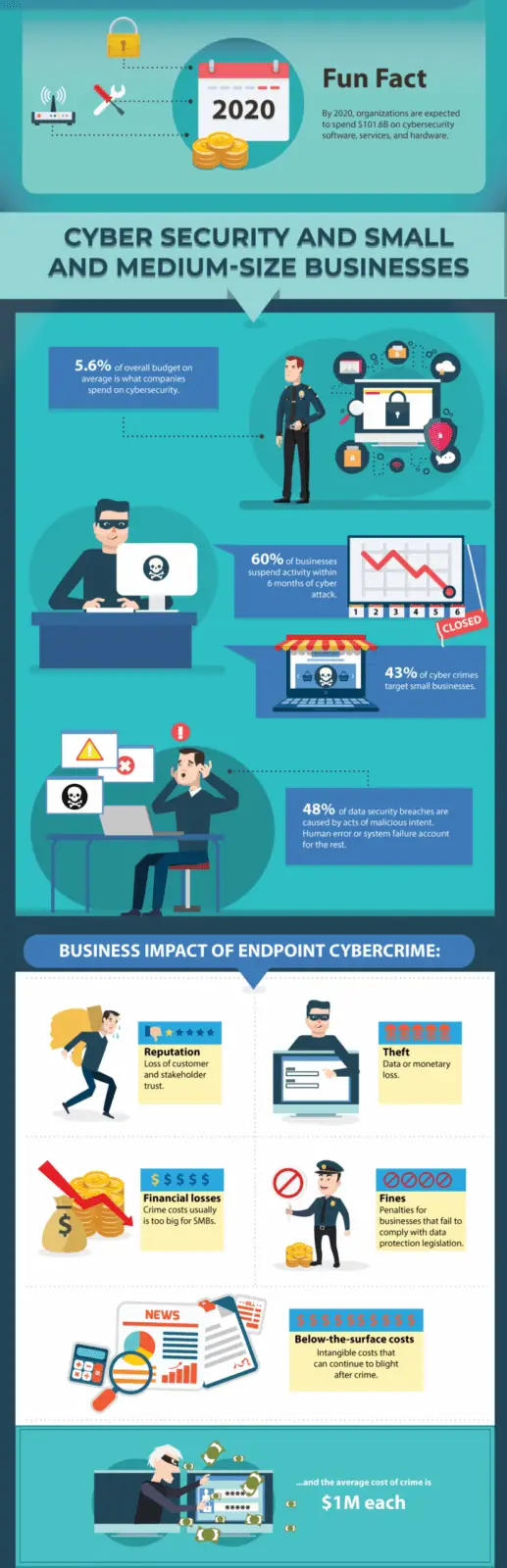
However, the use of business IT brings a whole set of cybersecurity and compliance risks. Business digitization means using sensitive information, such as customer personal information, to render services. As of 2019, it was estimated that the world generates at least 2.5 quintillion bytes of data every day. Business data makes up a significant chunk, and this provides hackers with increased incentives for breaching companies. This, perhaps, explains why businesses are the most targeted by cyber adversaries. 43% of the total cyber-attacks target small businesses, while 64% and 62% of companies have been victims of web-based attacks, and social engineering or phishing attacks, respectively. This indicates that every business should heavily invest in cyber defenses. Just like any investment, it is necessary to make sound cybersecurity investment decisions to ensure maximum ROI (Return on Investments). Here are the top trends that should inform cybersecurity spending in 2020.

Approaches to consider when setting up cybersecurity budgets

Since the cyber threat environment is highly dynamic and keeps changing, allocating sufficient budgets to cybersecurity is of utmost importance. According to recent standards, most organizations allocate 10% of IT budgets to cybersecurity. However, such a small percentage may not be enough to completely secure the IT environment, invest in awareness and security training, acquire new cybersecurity solutions, or ensure full compliance with mandatory regulations. As such, businesses should focus on the following three approaches when setting up cybersecurity budgets for 2020.

  1. Being proactive rather than reactive

Cybersecurity budgets should be a priority for all businesses. Yet, many organizations use a reactive approach, which in most cases, does not produce the desired results. For example, an adversary breaches a network, and the company suddenly needs to implement new firewalls, intrusion detection and prevention systems, antiviruses, and so on. While reactive or ad-hoc approaches might be efficient for some when budgeting for information security, cash-sensitive businesses cannot rely on the method to get critical cybersecurity projects approved. Besides, the main objective of cybersecurity budgets is to keep out adversaries to prevent cyber incidences from happening. It is, hence, sensible to edge away from reactive budgeting approaches to a more proactive one.

A proactive cybersecurity budget allocation approach means understanding and embracing the mindset of a hacker and use this knowledge to build strong defenses. This will require the in-house security teams to employ all their expertise at detecting all exploitable opportunities which hackers can use to intrude on a corporate network. The assessment results will guide the deployment of appropriate mitigation measures, thus remaining protected at all times. Small businesses that lack the resources to conduct their own risk assessments should consider outsourcing vulnerability assessments to red and blue pen testers.

  1. Benchmark organizations with effective cybersecurity budgeting

One essential question many companies are unable to answer when planning for cybersecurity budgets is, how is the enterprise performing in regards to detecting, preventing, and responding to security incidents? If unable to answer it, then a business should consider using a benchmarked approach to set and allocate cybersecurity investments and budgets. The approach involves comparing the business’s operating performance with that of other peers, a recognized framework, a group of sampled companies, or a previously conducted study. Observing the best security practices of different security teams can enable a company to quantify the results and prepare an appropriate cybersecurity budget. The benchmarking should be in terms of security investment levels, key performance indicators, and organizational cybersecurity structure.

  1. Adopt a risk-based cybersecurity approach when creating cybersecurity budgets

Setting cybersecurity budgets using risk-based approaches can help inform the level of investments. The approach requires the information security team first share risk categories affecting all areas with the leadership management team. It is more effective in organizations with mature security procedures. This is because they can categorize risks in multiple domains, and allocate sufficient budgets based on the costs involved in mitigating the risks. One of the most effective risk assessment and management framework is the NIST (National Institute of Standards and Technology) Cybersecurity Framework. It consists of five information security lifecycle domains, which are identify, detect, protect, respond, and recover.

Using the NIST CSF approach to identify and categorize risks informs the mitigation measures according to the degree of risk levels. As such, a business can identify risks that require a higher mitigation priority. This, in turn, informs the security investment decisions by first prioritizing the most impactful risks. Although this method is similar to the benchmarking approach, organizations can realize noticeable improvements in matters of security operations.

Cybersecurity trends should inform budgeting decisions

Before setting up 2020 cybersecurity budget allocations, it is critical for organizations to keep an eye on how the cybersecurity landscape might shift compared to previous years. In this case, there are three critical cybersecurity trends companies should prepare to address in budget preparations. They are as discussed below.

  1. Investors/clients will prioritize organizational cyber risks in their analysis

Cybersecurity will play a leading role in matters relating to investment decisions. With companies such as Equifax suffering profit and reputational losses due to data breach incidents, investors are more cautious when considering investment options. They are more hesitant to invest in enterprises with questionable risk management procedures. This is understandable given no one wants to entrust his personal information in risky environments. For these reasons, security teams should focus investments on risk identification and management. Having a strong security posture should no longer only involve preventing breaches, but also consist of sufficient risk management controls. Stronger risk management procedures and the implementation of safeguards and controls for protecting sensitive information should be at the center of all cybersecurity budget decisions.

  1. Attackers might focus on using brute-force attack techniques

In 2020, attackers might focus less on exploiting zero-day vulnerabilities, and instead prefer brute-force attack methods. Such techniques include gaining unauthorized network access through unpatched systems or insecure third parties. Actually, this trend has been identified in different attacks. For instance, APT33 utilizes almost exclusive password spraying and brute-force attacks when attempting to compromise critical infrastructure. Also, examples of successful use cases include companies breached using Shapeshifter and Shamoon, which are the main APT33 go-to deployments. Moreover, business email compromise attacks have been on the rise in 2019, with multimillion companies such as Nikkei losing up to $29 million to such ploys. The examples notwithstanding, NSA reports show that it rarely responds to cyber incidences involving zero-day exploitation, as opposed to incidents caused by unpatched software or hardware.

Countering these trends may require cybersecurity plans and procedures to focus on security basics. This is by building a strong foundation. Examples of such plans are continuously monitoring critical systems to identify new vulnerabilities and threats, and constantly evaluate the implemented security standards, including those of third parties and supply chain partners. Focusing cybersecurity investments on employee training and awareness creation can also enable a business to strengthen its security posture. More often than not, the human element contributes the highest towards weak security links.

  1. Cyber insurance will be more integral to cybersecurity plans

From BEC to ransomware attacks, the costs incurred in responding to attacks and breaches are rising by the day. Most businesses, especially SMEs, are incapacitated in incident response due to limited resources and lack of required expertise. Most are unable to respond to a wide variety of attacks, including those delivered through third, fourth, or fifth partners. Although most cyber insurance covers don’t pay for finances lost through attacks, they provide great assistance in financing legal fees needed for investigations. Every organization can be attacked in spite of the implemented defenses. The question is, how well is it prepared to recover from the attack and ensure business continuity? Through cyber insurance claims, a breached company can ensure quick investigations and remediation.

Furthermore, more businesses are acquiring various cyber insurance policies. Insurance companies will, therefore, become more familiarized with cyber attack nuances, and begin providing new coverage plans. They may even include plans for paying losses and damages resulting from attacks. As 2020 progresses, organizations need to understand and acquire available insurance plans, to effectively budget for what the policies don’t cover. Reevaluating current insurance plans can better inform the best cybersecurity budget plans.

Your 2020 cybersecurity budget should focus on the following things

  1. Awareness training for employees

In research done by Osterman, investing in cybersecurity education for employees has the highest ROI. Creating awareness on how to enhance resiliency towards security risks facing digital assets can deter a large percentage of attempted breaches. In most instances, hackers prefer exploiting users since they are regarded to be the weakest link in cybersecurity. This is by using undetectable methods through software or hardware, or by employing social engineering tactics like phishing, pretexting, and smishing. These are only preventable through educational awareness and training since technical measures have little success.

There are various budget-friendly methods companies can use to create awareness. These include using posters, emails reminding employees tip of the day, and contests. Cost-effective training strategies include using and fun educational videos, short computer-based courses, and formal training classes. Organizations can provide funds to be used in rewarding employees who demonstrate strong cybersecurity knowledge. This can motivate other members to be more serious with the training, thus creating a cyber aware culture.

  1. Proper patching

This might seem like the obvious, but observing strict patching policies can greatly strengthen a company’s cybersecurity posture. Inhouse IT teams should prioritize hardware and software patching. Yet, most managers overlook it, preferring to dedicate resources in other areas. Inadequate patching has been responsible for some of the largest breaches, including the 2017 Equifax data breach that compromised data of more than 140 million individuals.

It, therefore, goes without saying patching procedures should be allocated considerable finances. This is to ensure patch management is one of the focal points in weekly, if not daily, cybersecurity routines. Patching ensures hardware or software assets contain the latest updates and security to deny hackers exploitable vulnerabilities. If possible, investing in automated patching systems can ensure prompt update download and installation as soon as they become available. This not only enhances organizational security but facilitates compliance with various regulations.

  1. Outsource to cybersecurity firms

Sometimes, the scope needed to properly secure a company can take a toll on financial resources. Requirements like hiring in-house security personnel who should be available 24/7 is infeasible unless the company in question is a Fortune 500. But small businesses are the majority, and limited resources may prevent them from maintaining their own cybersecurity operations. Managed service providers provide a lot of professional services that are highly beneficial to optimizing security. These include 24/7 monitoring, access to specialized experts, and access to the latest security tools and policies. Outsourcing security is affordable since most MSPs provide affordable subscriptions, which can be paid annually or monthly.

Additionally, outsourcing security services like penetration testing are budget-friendly processes that can harden implemented defenses. Identifying risks and vulnerabilities beforehand ensures the implementation of strong solutions to prevent exploitation. Since pen testing can be done once or twice a year, companies can include them in budgetary allocations.

  1. Endpoint security

Protecting the endpoints is an effective strategy a business can use to secure its networks and data. Endpoints are the means a hacker or user can gain network and system access. These include mobile devices, smartphones, laptops, and USB ports on computers. There are numerous endpoints in any given company, such that achieving 100% security is near to impossible. Despite this, organizations should strive to invest in endpoint security. This might seem like an enormous investment, but there are security firms that offer managed endpoint security and response. They normally install software that accesses and monitors all endpoints for suspicious activities. Automated versions can detect anomalous activities and initiate appropriate responses with minimal help from human operators.

Several trends will impact your cybersecurity spending

Every year, new trends in the cybersecurity landscape emerge. Most have a significant impact on a company’s cybersecurity spending. The following ten trends might inform how you plan for cybersecurity budgets in 2020.

  1. Software lagging behind security services

Forrester dubbed 2019 as the year of security services. In that year alone, spending on cybersecurity services, which is a relatively new development, increased by four times. These outpaced investments made in other areas. According to a prediction by Gartner analysts, security services might account for at least 50% of the set cybersecurity budgets. More specifically, Gartner estimates that spending on security services, infrastructure protection, and network security equipment will amount to $64.2 billion, $15.3 billion, and $13.2 billion, respectively.

  1. Increasing privacy concerns

New privacy laws and regulations have been a cause for privacy concerns in previous years. 2020 will not be an exception, especially with the expected 5G network rollout. Privacy breaches are also causing most consumers to continuously ponder over the privacy and security of their data. As security services spending increases, companies must also consider investing in privacy protection. Cybersecurity budgets should focus on enhancing the functionalities of identity and access management (IAM) systems, data loss prevention (DLP) strategies, and identity governance and administration (IGA).

  1. CISOs want increased visibility, analytics, and alignment

An emerging trend is Chief Information Security Officers (CISOs) spending more on cybersecurity with the management’s approval. Setting up larger cybersecurity budgets is essential to addressing industry needs, business changes, and security risks. Due to adversaries’ ability to develop complex attack methods, CISOs are determined to create a well-integrated cybersecurity ecosystem. This is to enable threat identification in real-time and to develop a more strategic cybersecurity culture. Forbes predicts that CISOs might prioritize the following in budget spending:

Develop security event analytics to replace cross-platform visibility

Use orchestration and automation to align security operations

Acquire user behavior analytics (UBA) to address insider threats

  1. Compliance might be the key driver for cybersecurity spending

CISOs are today closer to the C-suite (executive level employees) than at any other time. A PwC study showed that most CEOs agree cyber threats are a huge threat and impediment to a company’s growth prospects. CEOs are more convinced that implementing more on compliance will enhance cybersecurity postures. CISOs, on the other hand, are concerned spending more on compliance at the expense of investing in mitigating digital business risks might be ill-informed. This means that business decision-makers must ensure to set aside adequate budgets for managing compliance and managing digital risks.

  1. Cybersecurity investments accelerates digital transformation

CISOs need to maintain effective collaboration with C-suite to ensure the better understand the technical aspect of cybersecurity. The aim of any technology-oriented company is to ensure the achievement of a secure digital transformation. Emerging technologies like 5G networks might result in automated business functions, which will transform how businesses operate. In particular, a CIO study showed that minimizing time and resource wastage, enhancing time efficiency, and reducing business friction are the key objectives of a digital transformation process. Ensuring secure digital transformation will require cybersecurity budgets to key enablers such as DevSecOps.

  1. Evolving ways of measuring cybersecurity ROI

Cybersecurity leaders are determining a product’s investment value by recognizing its ability to reduce security risks, and at the same time, enable an organization to remain compliant. These are the top metrics for most, and they might prolong into 2020. Inviting third parties to conduct audits on available tools and products might validate if they are efficient for security investment.

  1. Investing in a security culture is a key objective

People or process failure account for the majority of successful cyber-attacks. Sparking a conversation concerning cybersecurity budgets and risks can assist a business work toward achieving a strong security culture with shared risk goals. As such, executives should be able to justify cybersecurity spending by addressing existing shortcomings within a security ecosystem. To ensure the success of cross-functional budget conversations, topics such as appetite for risk, where security investments will result in the most significant impacts, and how to ensure existing investments yield desired values should guide the talk.

  1. Cybersecurity budget benchmarks are not easy

Although benchmarking the cybersecurity spending of other organizations is one of the recommended approaches towards setting up budgets, it is quite challenging. This due to factors such as company size and type of industry. A BCG report indicated that cybersecurity spending in some of the largest organizations variated by 300%. When benchmarking, therefore, it is vital to understand that strong cybersecurity should consider factors such as regulatory compliance, facilities, levels of security risks to IT assets, among others.

  1. Artificial intelligence will take center stage

Organizations should brace themselves for an upsurge in AI investments. 5G technologies will enable adversaries to develop intelligent malware that cannot be detected by traditional defenses. AI-enabled cyber defenses will be crucial to protecting organizational networks and IT assets. Hence, cybersecurity budgets should take into consideration the potential acquisition of new security technologies and policies.

  1. Change management

Change is a constant factor in organizational cybersecurity. This might be due to the introduction of new business processes and technologies. Planning for change beforehand can enable businesses to maintain adequate security. When preparing cybersecurity budgets, a special fund for catering security during change should be set aside. This is to ensure that the change does not result in downgraded security.

Cyber Threat Hunting – A Complete Guide

Cyber threat hunting is the process of proactively hunting for attackers or malware that are lurking in your network system and may have laid undetected. Just like real-life hunting, cyber threat hunting can be quite challenging and requires a uniquely trained professional with considerable patience, creativity, critical thinking, and a keen eye for sporting out the target prey. The prey may be quietly listening for confidential information, patiently siphoning off data, or working their way toward significant data, which can help them access crucial information or assets.

Every organization needs additional cyber protections in addition to commercial cybersecurity solutions. This need is because no system is 100% efficiently protected. Despite how advanced technology might be, there is still a chance that more advanced threats will maneuver the protection layers.

Basic hygiene and proper implementation of firewalls and other augmented security systems should stop many threats. However, once an intruder is in your network undetected, there may be less protection available to identify and remediate. On average, cybercriminals spend close to 192 days before being discovered on a system. This is more than enough time to cause considerable harm to a network.

Traditionally, most organizations have a security culture solely depending on the implemented security solution for system protection. The danger with this is that protection is often signature-based.  Signature-based solutions detect patterns based on known threats. But, newly developed malware with unique code is much more challenging to detect.

What is Cyber Threat Hunting?

A threat hunter is a security professional who usually works from a Managed Security Service Provider (MSSP) or the company’s Security Operations Center. Threat hunters are also referred to as threat analysts and employ both software and manual techniques to detect possible incidents or ongoing threats that may have intruded on systems.

Threat hunting is not an easy or straightforward task to carry out. It requires a highly skilled professional in cybersecurity as well as enterprise operations. It also requires knowledge of the business. Detecting an abnormality within a network may be as simple as discovering traffic decrease or increase to an unusual state.

Advanced threats are delicate as some (such as exfiltration techniques) use covert channels or encryption techniques. For example, in DNS Tunnelling, data is coded in DNS responses and queries. It looks nearly the same as that of a normal connection. A good threat hunter can identify anomalies such as fluctuation in DNS traffic per domain or the size of requests and responses.

Tools for Cyber Threat Hunting

Threat hunting is extremely complicated and involved. Even an experienced hunter would fail without proper tools. Essential items include the following.

  • Baselines – this is an indicator and should be laid out before the detection process starts. Baselines are of immense value. A baseline defines what is authorized or expected to pass through a traffic network. Baselines make it easy to identify anomalies that require investigation.
  • Data – access to key logins to devices on a network’s system is critical for every hacker. Devices of importance may be databases, servers, and endpoints. These devices contain important data. One technique includes creating a central point for assembling the data for analysis. Collection, correlation, and standardization of data from the various data points are essential. A common tool for data collection is a Security Information and Event Management (SIEM) device.  A SIEM device is a threat hunter’s best weapon.
  • Threat intelligence – cybercriminals sometimes cooperate, sharing malicious artifacts, codes, and information. An increase in the frequency of similar attacks implies a corresponding rise in the number of companies identifying the attacks. An efficient threat intelligence system should acquire actionable knowledge from multiple sources about threats to an environment.

An efficient Intel system on the emergence of a new attack enhances a hunter’s ability to spot indicators of compromise or indicators of attacks (IOAs) within a network and ample time to act on this information.

What to Look for When Cyber Threat Hunting

The starting point of every threat hunting process is the definition of prioritized intelligence requirements (PIRs). PIR questions and answers derive appropriate response actions.  For example:

From where does a threat emanate?

Does the daily alerts and multitude of logs dealt with daily indicate undetected cyber threat?

What are the most valuable assets owned by the company that may be of interest to hackers, and what are some of the probable ways that the black hats can use to gain access?

With this kind of high-level questioning, it will be easy for a threat hunter to get a response to specific information gaps. Some other questions may be:

What is the number of low-level alerts connected to a particular threat?

Are there deviations from logs of the past 30 to 60 days as per the current information on threat intelligence?

Are there anomalies such as the use of strange commands?

Therefore, during hunting, a threat hunter should look for data, analyze and interpret the results as per the given tool available, identifying abnormalities, and coming up with the right steps to stop active threats.

Where Does Cyber Threat Hunting Fit?

Threat hunting complements the standard process of identifying threats, reactions, and remediation. Traditional methods analyze raw data and generate warnings, while threat hunting works parallel with automation and specific queries to extract lead from the same data.

Human threat hunters then analyze the extracted leads. The professionals must be skilled in identifying signs of malicious activity. The identified indicators are managed via the same pipeline.

Defining an Ideal Hunting Maturity Level

Threat hunting programs are categorized into levels based on the following three key factors;

  1. Experience and skill of the threat hunter
  2. Quality of the information collected.
  3. Tools and methods used to collect and analyze data.

At the initial maturity level, there is minimal or no routine for collecting data. The organization solely relies on automated alerting. The human effort focuses on alert resolution. At this stage, the organization is considered not capable of threat hunting, even with an experienced hunter.

It takes effort to reach a higher level of maturity, and as expected, there exists a significant difference between the results from different levels. For example, an organization at its procedural maturity level can use adapted procedures to collect data, thus making threat hunting a reality.

HMM 0 Initial

  • Primarily relies on automated alerting.
  • Little or no routine data collection

HMM 1 Minimal

  • Incorporates threat intelligence indicator searchers
  • Moderate or high level of routine data collection

HMM 4 Leading

  • Automates the majority of successful data analysis procedures
  • High or very high level of routine data collection

HMM 3 Innovative

  • Creates new data analysis procedures
  • High or very high level of routine data collection

HMM 2 Procedural

-follows data analysis procedures created by others

– High or very high level of routine data collection

Despite the significant difference between hunting results from the various levels, it is still vital to assess and point out the ideal level for a threat-hunting program.

In most organizations, threat hunting is done after the occurrence of an event.  This is reactive threat hunting. Mature threat hunting requires proactive hunts to keep eliminating threats that may or may not exist. Lack of an apparent threat implies no clear starting point, endpoint, or path through the hunt.

Cyber Threat Hunting Process

Threat hunting is a multi-stage process that takes place in a cyclic manner. The hunter does not know what to look for, as the hunt is proactive. It begins with defining the threat hunting goal. The next step is analysis. The final step is remediation and response to purge the threat from the system. Below is a description of the various stages:

1.  Defining the hunt

The first stage of the hunt is to figure out why the hunt is necessary. In this stage, you point out the main reasons why you are performing the hunt. Conducting an undirected hunt is likely to go astray since there is a wide variety of potential threats and data to fetch. It is preferable to have a series of small segments of a directed hunt than one large undirected hunt.

Conducting a proactive threat hunt implies that there is no specific threat to hunt. Therefore, defining the hunt becomes difficult. Below are two ways to define a hunt: data-driven hunting and target-driven hunting.

 –  Target-driven hunt

A target-driven hunt determines if a particular threat exists within a network at that given time. Examples include:

Tools, techniques, and procedures (TTP) of an advanced persistent threat.

Indicators of Compromise for undetected attacks

Specific attack vectors from MITRE ATT&CK framework.

Having a target before the actual hunt helps to set a starting point for the search and, more significantly, streams focus towards a specific type of data to be collected. During the hunt, evidence of a threat or other critical information may be found.  This may result in a change in focus.

–  Data-driven hunt

This is where the hunt begins by first collecting a given set of data. Afterward, a comprehensive analysis of the collected data is performed to determine if there may be some anomalies lying unnoticed within that data set. These found anomalies form a starting point for a more specific and detailed hunt.

When choosing which data set to begin your hunt with, it is necessary to consider the attack life cycle. It is preferable to settle on a data set that would allow the detection of one or more threats.

2.  Data collection

Good threat hunting is a reflection of the quality of data collected. If the analysis is based on incomplete data, the hunt is also half-good and only gives a false sense of security. The threat hunter should be revisited multiple times during the hunt.

During the hunt, it may seem as more data results in a better outcome. However, this might not always be the case due to the following reasons:

Volume – a collection of more data means that more data will be available to be processed. Depending on the hunt’s circumstances, a larger amount of data may only result in more time required.

Visibility – enhanced adversaries available within the network are likely to detect and evade data collection efforts.

Processing – some techniques work best with smaller data sets than larger data sets, such as grouping and stack counting.

It is better to focus on the information required to answer the core question when performing a threat hunt. The hunt should also be a continuous process, with the past hunts forming the base and motivation for future hunts.

3.  Analysis of data

Data analysis can be one of the most challenging tasks as there is a large amount of data to be analyzed at very high accuracy levels. Some data logs use advanced techniques such as encryption and encoding to remain concealed even after being collected. A hunter should be keen and eliminate even those logs that split attack payload into small packets to thoroughly check through every bit of collected information, asset, or data.

At the finish of the analysis, two results are expected;

  • If the hypothesis is not as per your definition of the hunt: then perfectly okay! This implies that there is no evidence to confirm the presence of an attack agent with the system. This should be reported, case closed, and the next set of data or PIR requests analyzed.
  • If the hypothesis is correct: if there is enough information to confirm the stated hypothesis, the hunter should immediately check the nature, extent, and effect of the attack on the system. Finally, the hunter should also be able to define an effective response to counter the threat.

4.  Response to attack

In conjunction with the entire hunting team, the hunter must create the best response to the threat. The response should distinctively define both short-term and long-term response measures used to cub the attack. The response’s main goal is to immediately put an end to the ongoing attack, prevent the system from damages by a perceived threat, and finally eliminate chances of the attack happening again in the future. The response can be defined to protect the affected host and any other similar gadget, server, or system.

5.  Learning from the attack

After garnering enough evidence to confirm that an attack occurred, the hunter should now use this information to prevent similar events in the future. The basic idea here is to introduce a blameless approach other than a finger pointing a single threat.

Humans are fallible creatures by nature; therefore, the lesson-learned stage’s main goal should be to improve the security process by considering every element. The human factor is a significant threat and can be an exposure targeted by black-hats. For instance, failure to apply a security patch can lead to intrusion into a system. In this case, firing the person involved would not eliminate the threat or resolve the solution. Instead, a better response would be the implementation of a patching procedure throughout that working environment.

Cyber Threat Hunting – How to do it effectively

Unfortunately, no system can claim to be 100% secure, and many companies and organizations have to bear consequences such as loss of revenue and data breaches. Companies expect their threat-hunting program to be effective at the start of every hunt, and they have success in mind. But do they typically achieve this? Are their systems without hidden threat agents? What techniques do successful hunters use?

Below is a brief look into some of the effective threat hunting tips to use while responding to pesky cyber-attacks and to avoid substantial financial losses or compliance-related issues.

1. Have a near-perfect knowledge of your environment

Threat hunting aims to identify and eliminate abnormal activities that can negatively impact a network server or system. A good understanding of your environment and its regular activities are prerequisites for understanding abnormal activities. Any abnormal activity should stand out and easily be noticed by an individual if they understand the normal operational activities.

2.  Reason out from an attackers’ position

Typically, a hunter’s job is to proactively search for adversaries and mitigate impact or damage to the system. A good hunter should target at anticipating an attacker’s next move. With this next move in mind, a threat hunter should set up triggers to alarm immediately when an attacker makes the expected move.

3.  Implement an OODA strategy

The OODA strategy is similar to a military tactic used in combat operations. ODDA refers to Observer, Orient, Decide, and Act.

Observe – involves routine data collection.

Orient – combining collected data to make sense of it

Decide – after the analysis, formulate an incident response strategy to counter the identified course of action.

Act – this is the last phase, and it involves putting an end to the intrusion and appropriately adjusting a company’s security posture.

4.  Employ the use of sufficient resources

Currently, threat hunting is among the best security solutions. Therefore, a productive threat hunt will require competent personnel, adequate systems, and up-to-date tools to be successful.

5.  All endpoints should be protected

Neglecting certain endpoints may leave loopholes for adversaries. Endpoints, in this case, include all network devices, their activities, authorization, and software that they run on.

Other tips include;

  • Having an in-depth understanding of attack patterns and activities
  • Always consider the human element while hunting.
  • Have a record of your hunts
  • Remember that even the best weapon rusts if it is uncared for
  • Know the current threats

Cyber Threat Hunting – Conclusion

The practical value of threat hunting is that it allows security teams within an organization to proactively investigate the cyber environment to detect attacks and threat vectors that have bypassed traditional techniques.

Implementing an effective threat hunt is a challenge, hence the need for a formalized process. A proper hunt can be achieved with the right mix of experienced personnel, data collection and analysis techniques, and a comprehensive response structure.

Remember that no environment is fully protected and that even the most hidden threat will leave a trail. A pick of the right threat hunters is enough to generate the proper response. It is an intelligent move to invest in threat hunting as a company and an essential move to ensure that the organization is safe from the ever-evolving cybercrime industry.

6 Top Cybersecurity Disasters You Need to Know

The cybersecurity landscape has been “quite busy” as organizations have committed many investments towards their cyber defenses. Despite this, cyber adversaries have managed to outmaneuver some companies, causing severe attacks and data breaches. Some of these are serious enough to be considered disasters. It is vital to know about the top cybersecurity disasters in recent history.  We explain their impacts and their resolutions.

1. Ransomware attacks

Ransomware attacks have been prevalent. The healthcare industry alone has lost over $25 billion to ransomware attacks. A survey drawing cybersecurity professionals from various industries showed that 81% believe that this past year has had more ransomware attacks than any other year. Ransomware criminals have continued to target organizations in industries such as healthcare, education, and industrial plants.

Hospitals closed in the U.S. and Australia.

Ransomware attacks targeting healthcare facilities caused hospitals to shut down major operations. In a press release by DCH Health systems, criminals launched a ransomware attack preventing staff from accessing computer systems. The hospitals, located in Alabama, had to use emergency procedures to provide care to patients in dire need. An administrative official was quoted saying that “it is in the best interest of patient safety that DCH Regional Medical Center, Northport Medical Center and Fayette Medical Center are closed to all but the most critical new patients”.

In an isolated incident, California-based medical practice Wood Ranch Medical put out a notice on September 18 that it will shut all operations on December 17. The health facility stated that a ransomware attack had caused it to lose extensive patient medical records and information. In the announcement, Wood Ranch Medical said that “the damage to our computer system was such that we are unable to recover the data stored there and, with our backup system encrypted as well, we cannot rebuild our medical records”. This is a clear indication of the severity of the ransomware attack, which encrypted all files stored locally and backups.

Also, ransomware attacks in Australia’s southwest Victoria and Gippsland affected seven major health providers’ operations. The affected facilities had to either revert to manual operations or completely shut down health services. Victoria’s Department of Premier and Cabinet issued an advisory that a ransomware attack incident prevented the hospitals from accessing critical systems, including financial management systems. The hospitals had to isolate the systems and disconnect them in a bid to quarantine the ransomware infection. Some of the affected systems critical to daily hospital operations included information management systems, booking, and patient health records.

The LockerGoga menace cripples Norsk Hydro

2019 saw the emergence of a new ransomware variant. Known as LockerGoga, the malware is different from its predecessors, which merely encrypts systems and files until the affected victim pays a ransom. Instead, the LockerGoga ransomware variant modifies the local accounts of an infected system by changing the users’ login credentials. The malware then forces a system log-off such that a password must be provided to log back in. Like other ransomware attacks, the victims either pay the ransom to regain control or revert to manual operations. The LockerGoga variant also contributed its fair share in the topmost cybercrimes in 2019.

Norsk Hydro, a global aluminum producer, was infected by the LockerGoga malware. The company discovered the March attack after some vital systems began malfunctioning. The company’s CIO stated that the attackers had already gained access 2 weeks before the attack. The malware was executed on 20th March, and Norsk Hydro had to disconnect its worldwide network.

The company revealed that the attack had impacted most of the essential systems needed for production. These included the digital systems implemented in Hydro’s smelting plants. The infection was devastating to the point where Norsk Hydro had to shut down its metal extrusion plants and switch to manual operations. Although LockerGoga is only used to execute limited attacks, it has a greater impact than other ransomware variants like WannaCry and NotPetya. In Hydro’s case, it only infected the company’s central active directory server. This, however, impacted all of the company’s workstations at the same time.

The attack took Norsk Hydro well over a month to stop using manual operations and restore its digital systems. So, how did the company handle the attack? The first thing Norsk Hydro did was immediately isolate the infected systems. The company used a single domain for its admin systems and networks. Luckily, it did not use the same domain for its cloud-hosted Microsoft Office servers or its industrial control system. The attackers were able to change admin passwords since there were using the same domain. The infection spread rapidly, which would not have been the case had the company segmented its passwords and used separate domains for admin accounts.

LockerGoga hits and disrupts operations at Altran Technologies.

Altran Technologies is a French-based company that provides global engineering consultations and innovations. On 24th January 2019, the cyber adversaries used the LockerGoga ransomware and targeted the company’s networks. The highly acclaimed R&D services provider gave a press release stating that the attack had encrypted important files and data and had spread throughout its networks. The company also said that it was shutting down all of its applications and IT networks to contain the attack and, more importantly, secure its client’s data. The decision affected major operations in different European countries as Altran Technologies is a global organization.

Nevertheless, the attack did not lead to data losses, nor did it propagate to the networks or applications of Altran’s clients. Some of the global organizations that relied on Altran services and were affected by the breach include Iridium, a U.S. satellite operator, Ocado, a British online supermarket, Britain’s Network Rail, and Engie, a French utility organization.

2. A wave of supply chain attacks

Supply chain attacks increased tremendously in 2019. These are attacks that start deep in the supply chain of a software development process. The attacks target organizations that have deployed less-secure components in their supply network. Also, supply chain cybercriminals aim to target software suppliers and developers. The goal is to gain access to building processes, update mechanisms, or source codes to deploy malicious codes. This infects a malicious application with undetectable malware, thus distributing it to millions of users. There have been such cases in 2019 which have affected many individuals.

Barium group waging supply chain attacks using backdoors

Barium is a cybersecurity threat group that has used supply chain attack techniques to distribute malware to unsuspecting victims. During this year, the group has been exploiting trusted applications and software updates. The tactics have been successful since the group infected over 1 million software users in different parts of the world. According to Kaspersky Security Lab, one of the group’s tools during its 2019 campaigns is the ASUS Live Update Utility. The group stole the software’s legitimate digital certificates and used them to develop malware. Since it used the exact digital certificates, the created Trojans were similar to the ASUS Live Update Utility, preinstalled in ASUS computers.

With its hands on the software’s digital certificates, the group could conduct advanced persistent threats (APTs). The attackers used the network adapters’ unique identifiers to hardcode tables in the backdoors they had created in the stolen utility. As a result, anyone who installed the update utility would immediately check if the user was among those targeted in the attack. The attackers accomplished this by using the backdoor to check the created tables. Computers that matched the tables indicated network activity, which permitted Barium to access long periods without being detected. The attack was a wake-up call to the cybersecurity community as it was a clear indication of how easy it is for a supply chain attack to cause harm.

3. First American data leak

A cybersecurity disaster does not only consist of attacks or data breaches. Sometimes, organizations store highly sensitive data without applying sufficient security controls. Poorly secured databases have time and again been accessed by unauthorized parties compromising millions of data owners’ personal information. First American is an example of such an organization. The company is one of the largest real estate and title insurance companies on the planet. In May 2019, a security researcher, Brian Krebs, discovered First American’s database on a publicly accessible platform. The database had been exposed to the public without any measures for preventing unauthorized access.

As a result, anyone could have accessed over 885 million records containing highly sensitive client financial data—some of the information dated back to 2003. The company is yet to confirm whether the data was accessed illegally, but the incident could have been catastrophic if malicious actors obtained the information. Some of the exposed information included customer bank account details, tax and mortgage documents, transaction recipes of all the company’s clients, driver’s license details, social security number, among others. Since the company provides real estate agents and is also an insurance provider, cybercriminals would have used the data to commit a wide range of identity theft crimes. The company and customers alike would have suffered huge financial losses, privacy violations, property theft, and so on.

4. Yet another largescale breach on Facebook

Facebook is indisputably the largest social media platform in the world, boasting over 2.3 billion users. The company has been rocked by numerous breaches and privacy violations, forcing the CEO, Mark Zuckerberg, to appear before the U.S. Congress to shed more light on the increased attacks. Despite the company implementing more stringent measures for protecting user privacy, it still suffered a fatal data breach in 2019.

The company suffered a data breach that compromised the accounts of more than 419 million users. The breach impacted databases housing phone numbers of the affected individuals. Encryptions or passwords did not protect the databases linked to the users’ account IDs. As such, anyone could have found and accessed them. The exposed databases contained information of users located in different geographies. While revealing the breach, Zack Whittaker stated that the exposed databases were for users spread across different regions. 50 million records were for users located in Vietnam, 18 million records were for U.K.-based users, and 133 million of the exposed records were for users in the United States.

It is also important to note that each exposed record consisted of the users’ unique Facebook IDs and phone numbers listed as connected to the corresponding accounts. Imagine what a hacker could have done with the information. The phone numbers, for instance, could be used to reset the password for each account, thus providing unlimited access. The breach comes after Facebook announced in 2018 that it would enforce more measures focused on restricting access to user data. The massive and embarrassing breach confirmed that Facebook is yet to realize sufficient privacy protection measures. Further investigations showed that other types of personal data exposed in the breach included user location by country, gender, and usernames.

While addressing the breach, a spokesman from Facebook said that although the database contained information regarding Facebook users, the server hosting them did not belong to Facebook. The spokesman also added that the exposed datasets seemed old and appeared to be containing information acquired before the company made changes in its widely popular platform; among the implemented changes included removing the ability to find Facebook users by searching their phone numbers. The datasets were taken down to contain the breach, and the company was quick to point out that the breach did not compromise any accounts.

5. Cyberattacks take down thousands of websites and a TV station in Georgia

The BBC reported a massive cyber-attack that took down over 2000 websites and a national television station in Georgia. The attacks also affected court websites that have vital personal information and case materials. In most instances of the attacks, the hackers replaced the site home pages with the picture of the country’s former president, President Mikheil Saakashvili. The images were captioned “I’ll be back”, most likely meaning that the attack was politically instigated or it was state-sponsored. At the time of reporting, the origin of the destructive attack was yet to be known. Security experts and pundits, however, believe that Russia could have been behind the attack.

Nevertheless, many cybersecurity professionals attribute the success of the attack to the poor website security measures implemented in Georgian government websites. The poor protection caused the websites to be vulnerable to attacks. Consequently, at least 15,000 web pages were hacked into. Among the affected sites included those belonging to private companies, the presidential website, and non-governmental organizations. The attack was so severe that it took down the national TV station Imedi. The attack paralyzed the TV station’s operations for more than one hour. Another network, Maestro, was also a victim of the attack. The nationwide attack reportedly destroyed or damaged the network’s computers and vital equipment.

Following the attack, a cybersecurity professional based at Surrey University, Prof Alan Woodward, claimed that the attack’s magnitude was like anything the country has never seen before. The attack was destructive and affected the entire country, prompting the professor to argue that “it’s difficult not to conclude that this was a state-sponsored attack”. Despite the attack being significant, it did not affect any of the nation’s critical infrastructure.

6. Cyberwarfare between U.S. and Iran

Many cybersecurity experts believe that cyberwarfare will most likely be the preferred attack method between nations in the future. This already seems to be the case demonstrated by the recent cyber warfare between the U.S. and Iran. The U.S. had earlier this year accused Iran of being responsible for attacking oil tankers in Saudi Arabia and shooting down an unmanned U.S. drone. Although Iran furiously denied the former accusation, it was quick to point out that the drone it shot down had violated Iranian airspace. U.S. President Donald Trump ordered a military strike which was canceled at the last minute. Instead, the country opted to execute a series of cyber-attacks aimed at Iran’s weapons systems that control rocket and missile launchers.

Sources privy to the attack revealed that the country had planned it many weeks in advance. The attacks targeted weapons systems under the control of the Islamic Revolutionary Guard Corps. According to AP news agency, the U.S. succeeded in taking the weapon systems offline, although for a small period. The attack, however, nudged Iran to execute retaliatory cyber-attacks. The U.S. Department of Homeland Security had warned against the attacks, and it did not take long for Iran to start executing them.

The director of Cybersecurity and Infrastructure Security Agency, Christopher Krebs, warned of malicious cyberactivity targeting U.S. government agencies and industries. Iran’s cyber actors and several of their proxies were held responsible for the attacks. Krebs said that the actors used destructive attacking approaches by using credential stuffing, password spraying, and spear-phishing methods. The Iranian attackers were also trying to hack into the U.S. naval ship systems. Thankfully, none of the attacks were successful since the scope of destruction would have been unfathomable. Cyberwarfare can destroy critical national infrastructure, not to mention that malicious actors in control of U.S. naval ships could attack the same people the ships should be protecting.

Conclusion

The cybersecurity disasters of 2019 show that it is indeed pertinent for all organizations to protect themselves better. In fact, nations need to step up their cyberspace security to prevent cyber warfare attacks like those between Iran and the United States. The only way to ensure maximum security in the private and public (government) sectors is for both to form a partnership. The private sector has the resources and expertise, whereas government agencies like the U.S. Cybercommand have unique capabilities. The private sector uses innovative strategies to formulate successful cybersecurity strategies. As such, private cybersecurity professionals draw a lot of expertise from creating a huge percentage of a country’s critical infrastructure. Supplementing this with the government’s capabilities would enable a country to realize a fully secured cyberspace.

Furthermore, public-private partnerships in cybersecurity would allow both sectors to share vital information. Information sharing has been the norm in sectors about security. Timely dissemination of information would enable private organizations and the government to implement the best cyber defenses to counter any form of aggression.

More importantly, joint cybersecurity partnerships between private and public sectors can facilitate a coordinated approach in enhancing risk assessments and management. Technologies and new threats emerge every other day, and it would be impossible for one sector only to achieve the desired levels of security. Collaborative risk management processes allow both sectors to support each other in managing all emerging threats.

Additional cybersecurity measures for both public and private organizations are:

Encrypt and password-protect databases and servers

Some of the top cybersecurity disasters could have been prevented if the affected organizations secured their databases with encryption. All companies should learn from First American and Facebook’s mistakes and secure all databases containing personal information. Password security should be reinforced by multi-factor authentication to ensure only individuals with correct permissions have access.

Implement website security practices

Georgia suffered a massive attack since most of the government and private organizations’ websites had poor security. Hacked websites can result in huge financial and business losses for the affected entity. To prevent this, some of the best website security controls include implementing firewalls to protect the sites and the web servers, frequent assessments to detect vulnerabilities requiring mitigation, and ensuring compliance with available regulations.